Picture this: you just arrived at school on the first day of your first year of teaching. You could hardly wait for this moment! You worked relentlessly to graduate, pass the necessary certification exams, and interview for your dream job. All you could think about the last few days while setting up your classroom was the anticipation of meeting your students for the first time. Then, your first day goes amazingly well! You feel incredibly lucky and fulfilled to be doing something so meaningful. But soon after, you realize you are on the biggest rollercoaster of your life, looping through survival and disillusionment (Moir 2013). As you reach the end of the semester and see winter break approaching, your rollercoaster car begins to wind through rejuvenation and reflection, only to start with anticipation all over again as you return from the holiday (Ginsburg 2011).
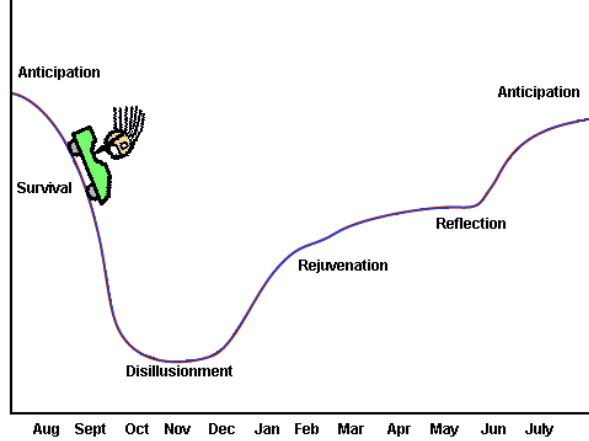
For many first-year teachers, this rollercoaster is not just a metaphor but is a daily, genuine reality. The survival stage can bring long nights of lesson planning, feelings of self-doubt and of imposter syndrome, and the heavy emotional weight of wanting to do right by each and every student. Disillusionment may follow close behind as teachers begin to realize that a passion for teaching alone does not eliminate the many challenges educators encounters, such as exhaustion, student behavior, heavy workloads, and/or limited resources. Furthermore, modern educators can carry significant additional burdens that can rapidly accelerate burnout, such as managing complex parent and caregiver communications, navigating expectations, and fulfilling unpaid services to the school, such as being asked to coach a sport or run a student organization (Einav et al. 2024). Over time, however, moments of rejuvenation will emerge through small victories such as student success, a heartfelt thank-you note, or a lesson that brings about a lightbulb moment. Reflection can then become the part of the track connecting the fight of exhaustion to renewal, allowing teachers to process their experiences with a restored sense of purpose. Being able to recognize these stages as normal rather than disheartening can help first-year teachers feel less alone and instead more equipped to persevere despite the challenges that they will inevitably encounter.
During my first year teaching, there were days when I questioned whether I was truly cut out for the job. One teaching day in particular stands out the most. After a gamified test review over imaginary numbers that I had worked so intensely on planning, the real deal felt disorganized and unsuccessful. I sat alone in my classroom long after the dismissal bell, crying and replaying every moment I wished I had handled differently. Instead of letting that day define me, however, I began writing about it. Journaling allowed me to separate one difficult experience that day from my identity as an educator as a whole. Throughout that school year, this practice of reflection shifted my focus from feelings of failure to moments of growth, helping me recognize progress that might otherwise have gone unnoticed. First-year teachers should consider reflecting in a journal after each school day. Specifically, write about an area where you did a good job that school day, but also identify a space where you have room to grow. Research shows that reflective teaching can support professional growth and reduce negative outcomes, like burnout (Navidinia and Gholizadeh 2025). To make this practice immediate and actionable, teachers can use the following targeted prompts to guide their daily reflection:
Reflective practices support not only professional development but also emotional regulation (Jennings 2015). By intentionally identifying moments of success, teachers can counterbalance the stress of the teaching profession. This process encourages a mental shift, allowing educators to view challenges more positively. When reflection becomes part of your routine, it fosters resilience by reinforcing a sense of skill and purpose. For early-career teachers in particular, these practices can serve as protective factors against burnout, grounding them in the “why” that brought them to teaching in the first place.
As a current third-year teacher, I can confidently say that the first-year teaching rollercoaster does not disappear with experience, but it does become more navigable. With this intentional reflection, the highs begin to outweigh the lows. Teaching will always be demanding, but it is also incredibly rewarding. By learning to reflect and rejuvenate, fellow educators can remain grounded in their purpose and continue showing up for their students, and themselves, year after year.
References
Einav, Michal, Dan Confino, Noa Geva, and Malka Margalit. 2024. “Teachers’ Burnout – The Role of Social Support, Gratitude, Hope, Entitlement and Loneliness.” International Journal of Applied Positive Psychology 9: 827–849. https://doi.org/10.1007/s41042-024-00154-5.
Navidinia, Hossein, and Fatemeh Zahra Gholizadeh. 2025. “Reflective Teaching, Teacher Immunity, and Burnout: Investigating Possible Links.” System 135. https://doi.org/10.1016/j.system.2025.103865.
|
|
Ms. Layman is a Math Teacher at Greenville High School interested in professional growth and development for herself and other educators around the world. |